#0423 - Bad Wolves, Bald Heads, Pickled Eggs, And Radio Beef - 09/14/2026
Monday arrives in East Idaho like a hostile government takeover, and Victor Wilt immediately establishes the central philosophical question of the entire program: how the hell are we supposed to survive five consecutive workdays after experiencing the forbidden luxury of a short week? Fortunately, Victor's computer is working, his weekend was productive, the lawn exists in a theoretically mowable state, and the universe has provided a suspiciously pleasant 67-degree day for backyard labor. Unfortunately, adulthood has once again presented its usual offerings of broken appliances, expensive groceries, expensive deodorant, expensive body wash, expensive gasoline, and the creeping realization that apparently every single object on Earth now costs $14. The weekend itself was a chaotic grab bag of yard-sale book hunting, household projects, zoo wandering during what appears to have been the internationally recognized Nap Time of the Animals, and an attempted reunion with The Troop, which was defeated not by the horror contained within the novel, but by the microscopic typography of the paperback, sending Victor into the ancient ritual of staring at his phone and going back to bed.
Then the music starts and immediately the show launches itself into the Bad Wolves Cinematic Universe. The band has released a heavy cover of Dolly Parton's “Jolene,” which has apparently generated controversy not because listeners are rioting in the streets, but because a former guitarist objected to the timing and circumstances surrounding the release. Victor's position is essentially: yes, they're probably capitalizing on the moment, but when exactly are people going to care about this song again? This somehow leads directly into the radioactive crater known as Rockzilla, the legendary Pocatello concert disaster involving torrential rain, thunderstorms, endless delays, and communication so spectacularly dysfunctional that a former Bad Wolves frontman apparently announced the show was canceled when, according to Victor, it wasn't. The episode therefore casually resurrects an old Idaho concert trauma before moving on as though nothing happened.
From there, Victor tries to establish hobbies as a wholesome path toward personal fulfillment, only for the internet to reveal that basically every peaceful hobby is actually a miniature psychological torture chamber. Fish tanks? Disgusting. Saltwater aquariums? Absolutely not. Gardening? Congratulations, you have now become a full-time unpaid employee of the plant kingdom, responsible for bugs, weeds, nutrients, pollination, watering, weather, and the eventual death of everything you lovingly planted. Bonsai? Apparently you can murder tiny trees through incompetence. Surfing? You're standing on a piece of wood in the ocean while nature possesses the legal right to erase you from existence. Road cycling? You're trusting your life to drivers who apparently can't be trusted to operate a vehicle without turning you into road paste. Sewing? One wrong move and the needle has personally declared war on your finger. Competitive hobbies? Automatically disqualified from the category of “peaceful” because the second humans introduce competition, somebody is going to start taking Grand Theft Auto Online personally. Victor's proposed hobby philosophy is therefore beautifully simple: if it requires maintenance, competition, other people, bugs, or a possibility of throwing a $70 controller into drywall, maybe just don't.
The relationship portion begins innocently enough with the internet asking women what men think they hate but secretly love, and immediately turns into the Great War for Male Friendship. Women apparently appreciate seeing their partners having goofy adventures with their friends, being vulnerable, enjoying hobbies, getting excited about obscure subjects, and generally behaving like actual human beings. Victor agrees with the fundamental concept but adds several emergency footnotes because relationships, apparently, come with an extensive terms-of-service agreement nobody reads. Guy time is good. Girl time is good. Last-minute plans are dangerous. A partner hating all your friends is dangerous. Being unable to tell your spouse you're overwhelmed is bad. A Magic: The Gathering nerd who makes dad and fart jokes and admits when he's feeling inadequate? Apparently that's relationship material. Victor's own enthusiastic camera monologues become Exhibit A in the ongoing investigation into whether your spouse genuinely enjoys hearing you explain something you're obsessed with or is simply waiting for you to stop talking.
Then the podcast wanders into the culinary wasteland of chain restaurants, where the internet has apparently declared war on civilization's most familiar food establishments. Panera is dragged into court. Subway is accused of no longer being what it used to be. KFC is interrogated. Pizza Hut receives a surprisingly vigorous defense. McDonald's and Applebee's are declared essentially fine. Victor's counterargument to the eternal internet complaint that “everything used to be better” is that maybe you just got older, your taste changed, and everything didn't magically become worse the moment you turned 30. Childhood food nostalgia gets put on trial as SpaghettiOs, canned ravioli, Lunchables pizza, ketchup abuse, and other culinary crimes against humanity are dragged from the basement. The economic angle makes everything even more ridiculous: groceries cost so much that sometimes feeding a crowd with Pizza Hut is easier than attempting to purchase ingredients and cook an entire meal yourself. The show has accidentally transformed a Reddit chain-restaurant thread into a dissertation on nostalgia, inflation, aging, food preferences, and the human tendency to remember childhood as though every meal wasn't occasionally a bowl of radioactive canned pasta.
And then: THE DOG LEG. Victor tackles the great canine mystery of the scratching reflex, arguing that the kicking leg isn't necessarily your dog communicating, “Yes, human, continue the sacred scratching.” Instead, it may be a nervous-system reflex, meaning your beloved pet could potentially be sitting there experiencing the canine equivalent of “WHY ARE YOU DOING THIS TO ME?” This naturally transitions into cats, because cats are already masters of communicating boundaries through violence, especially when paws or forbidden belly zones are involved. Then comes the e-scooter story, which produces a brief public-service announcement: don't get drunk and ride an electric scooter. Victor paints an exceptionally unpleasant picture of the consequences, because apparently nothing says “Monday morning” like imagining your face meeting pavement at scooter velocity.
The economic apocalypse continues with retirees being reluctant to spend their savings, which Victor immediately translates into “everybody is reluctant to spend money because everything costs an obscene amount of money.” The coffee maker has died. Gas is devouring roughly $80 a week. Trucks are expensive to operate. The Prius suddenly becomes an aspirational financial instrument. Even deodorant has become a luxury good. Somewhere in the middle of this fiscal nightmare, Victor launches into discussion of Flock license-plate cameras and reported cases of police misuse, including allegations involving tracking and stalking. The point is presented as a technology-and-privacy problem: license-plate-reader systems can be useful, but they can also be misused, which is why policies and procedures surrounding their use are being scrutinized.
Then the episode takes a hard left directly into BROWN WATER HORROR. Residents of St. Helena are dealing with brown tap water, and Victor immediately invokes the nightmare scenario of contaminated water, plumbing problems, and the infamous Cecil Hotel story. The underlying message is extremely straightforward: if the water coming out of your faucet looks like something excavated from a swamp, maybe don't drink it. Victor's color-based food-and-beverage safety standard is introduced with the memorable implication that brown is acceptable primarily when you're dealing with something like a cheeseburger or chocolate cake. Brown tap water, however, has failed the vibe check catastrophically.
The Freak News department then detonates when a village experiencing terrible cell service allegedly responds to the problem by tying up an engineer and demanding that he fix the internet. Victor immediately identifies the obvious operational flaw: you have physically restrained the person who needs to fix the thing you're angry about. The conversation then spirals into whether Jade could theoretically be tied up and dragged into his office so everyone else could take a nap. Somehow the hypothetical evolves into putting the engineer on a mountaintop near transmitters and rattlesnakes before the participants remember that cameras exist and that this is probably a terrible idea. This is precisely the sort of conversational escalation that begins with “people were mad about their cell service” and ends five minutes later with everyone casually designing a remote engineer containment facility.
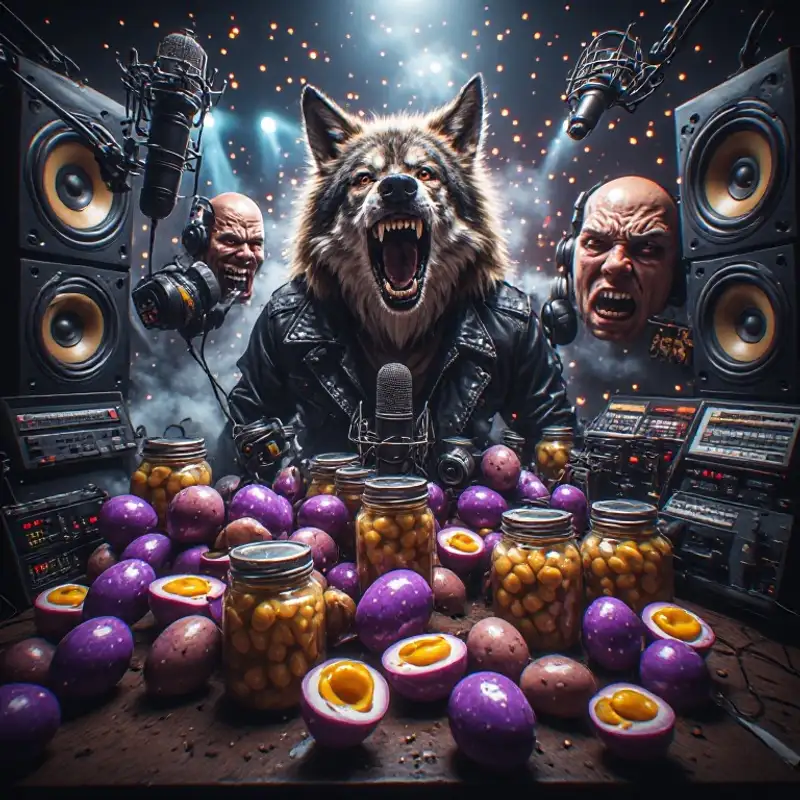
The studio conversation then gets contaminated by THE PICKLED EGG INCIDENT. Peaches and Victor compare weekend activities, the local fair, Fluffy, the farmer's market, and Becca's apparently unwavering devotion to pickled eggs. Victor recounts encountering beet-pickled eggs that had achieved a disturbing purple coloration and, against all reasonable survival instincts, actually ate one. The verdict: essentially a pickle-flavored boiled egg, but dry enough to make the Sahara Desert feel hydrated. This launches a full archaeological excavation of horrible foods previously consumed during the Noon Hour of Madness, including cold wiener pie, surströmming, and aspic—a gelatinous Great Depression-era food concoction that apparently contains meat, vegetables, and enough existential despair to qualify as a weapon. The studio then reopens the ancient legal case of Jade's Family's Horrific Deviled Eggs, with the conclusion that somewhere in the family tree a recipe was discovered that managed to make one of the easiest foods on Earth taste terrible.
Next comes Bald Is Beautiful Day, and the show immediately becomes an international tribunal on hair loss. The solution proposed for men losing their hair is brutally simple: shave it. Hair transplants are mocked through horrifying imagery of swollen post-surgery faces, Turkey procedures, and people who apparently emerge looking like they have spent six consecutive hours being attacked by hornets. John Cena enters the discussion as an example of somebody who could afford elite treatment but, according to the conversation, would also have looked perfectly fine bald. Then the show encounters the dreaded woodpecker haircut, the skulllet, Paul Heyman's ponytail, Devin Townsend's precariously attached dreadlocks, and the eternal temptation of growing long hair again despite the fact that shampoo and conditioner now apparently require financing.
The economics of grooming finally collapse into the creation of a new cultural movement: STINKMAXING. Body wash costs too much. Deodorant costs too much. Therefore, why buy deodorant when you can simply overwhelm your natural scent with an aggressively cheap bottle of cologne? Why stop there? Return to the sacred Axe Body Spray traditions of middle school and simply fog the entire room until nobody can determine whether you're clean or merely chemically camouflaged. The episode briefly suggests that metalheads are already halfway there because apparently deodorant avoidance is some kind of concert subculture. Capitalism has therefore forced the radio industry to reinvent hygiene as a tactical battlefield.
The conversation then unexpectedly becomes somewhat wholesome as Victor explains that he and his wife have been sleeping better, getting more done, going out in public, and generally enjoying their weekend without the previous exhaustion and irritability. The tone shifts from “everything sucks and everything costs too much” into a surprisingly sincere celebration of simply having a productive weekend and feeling good afterward. And then, because the universe cannot permit emotional stability for more than 14 seconds, Peaches introduces the saga of Ryan Hoppe, a six-foot-nine radio-adjacent internet personality whose social-media presence has apparently attracted the attention of an account known as “crappy radio jock.” What follows is an enormous rabbit hole involving Instagram posts, speedos, insults, screenshots, radio credentials, podcasting, and the bizarre sociology of people who have apparently decided that public social-media beef is their primary form of entertainment.
Victor and Peaches then begin investigating Hoppy Hour like two amateur podcast detectives who have just discovered an unexplored continent. Is Ryan Hoppe actually a traditional radio personality? Has he worked full-time on-air? Why are there episodes of wildly different lengths? Why is one allegedly 10 hours and 42 minutes long? What is Hammer and Hank? Why is music appearing in the content? And, most importantly, why does the microphone sound like that? Victor immediately starts diagnosing the audio processing, arguing that the vocal chain is simply turned up too aggressively rather than being properly processed to create the warm, compressed sound associated with classic radio personalities. Howard Stern, Mancow, Bubba the Love Sponge, and even Barry White are summoned into the conversation as audio-processing references. This is where the show temporarily becomes an unsolicited podcast-production seminar delivered by a man increasingly horrified by somebody else's microphone chain.
Then comes the copyright apocalypse. Victor argues that if you're operating an internet radio stream or podcast and playing commercially released music, you cannot simply slap a “fair use” disclaimer into the episode description and assume the legal gods have been appeased. Music licensing, rights agreements, copyright enforcement, streaming platforms, and potential strikes become the subject of a deeply skeptical investigation. The show uses this as a cautionary tale for anyone who thinks starting an online radio station means pressing “upload” and playing whatever music they want. Victor's underlying message is that Spotify is not a magical copyright-free dimension where the laws of music licensing stop existing.
And then the show enters the Bobby Bones Expanded Universe. Victor recalls accusing the mysterious “crappy radio jock” account of being Bobby Bones, which was denied, and Peaches responds by suggesting that if Bobby Bones really were behind the account, it would represent an extremely different and considerably more chaotic version of his public persona. The conversation contrasts the polished, audience-friendly world of country radio with behind-the-scenes radio personalities who reveal more of their actual opinions online. Victor argues that broadcasters inevitably pander to their formats and audiences to some degree, while the behind-the-scenes material can reveal a more candid personality. The entire segment becomes a bizarre love letter to the idea that radio personalities might actually be more interesting when they're allowed to stop pretending everything is awesome.
Finally, the episode enters its MEDIA WARLORD PHASE. Victor starts discussing Tomi Lahren and her complaints about social-media censorship, arguing that broadcasters giving medical information shouldn't be treated as medical authorities merely because they have a large audience. He repeatedly emphasizes going to qualified experts for detailed medical and scientific information rather than relying on influencers, Facebook posts, or TikTok videos. The broader discussion expands into criticism of opinion-driven news, partisan media ecosystems, audiences accusing straightforward local reporting of being politically biased simply because they dislike the facts being reported, and the increasingly blurry line between news and entertainment. Victor specifically points to East Idaho News as an example of a local outlet that can get attacked from different political directions simply for reporting information without presenting it in the ideological framing that a particular audience member prefers.
After all of that, the show somehow finds time to discuss whether Victor is allowed to “spew lies and propaganda” on air, determines that everybody waking up early enough to listen to morning radio is probably a little strange, insults the entire morning-radio profession, imagines other shows screaming down the hallway, and then suddenly realizes THE SHOW IS OVER. No dramatic conclusion. No graceful landing. Just the dawning realization that the morning somehow disappeared while everyone was talking about pickled eggs, bald heads, radio beef, copyright law, contaminated water, expensive deodorant, TikTok medical advice, and whether a dog kicking its leg means it loves you or secretly wants you dead. The program closes with a giveaway for Yellow Wolf and Highly Suspect at the Mountain America Center, with caller number 13 ultimately winning the tickets. And thus another completely normal Monday morning in East Idaho concludes, leaving behind only one unanswered question: how did we get from a broken coffee maker to a full investigation into internet radio copyright law?