#0446 - I Have Been Publicly Scolded By People Who Voluntarily Listen To Me - 11/05/2026
Welcome to another glorious installment of The Viktor Wilt Show, where the modern world continues to disintegrate at an alarming rate, politicians are apparently incapable of accomplishing the simplest tasks known to humanity, Facebook users have apparently forgotten how reading works, and Viktor Wilt is approximately one minor inconvenience away from abandoning civilization entirely and relocating to the California desert to live among the people who have officially opted out of society. It's Thursday morning, payday has arrived, the children have already begun harvesting the contents of Viktor's bank account, the mortgage needs to be paid, the coffee situation is unacceptable, and the general emotional atmosphere can best be described as a man standing in the middle of a burning building wondering whether it might be easier to just buy a cabin somewhere near the Arctic Circle. Viktor kicks things off by contemplating one of those mornings when you either scream directly into the heavens or throw your hands in the air, get into your truck, and drive until civilization disappears behind you. Slab City, California, is looking increasingly attractive, Red Dead Redemption 2 is apparently a perfectly acceptable substitute for human interaction, and if you haven't tried screaming outside to release your frustrations, Viktor recommends giving it a shot. Apparently, it's been one of his primary coping mechanisms since his teenage years, and he credits it, at least partially, with his eventual involvement in a metal band. Honestly, that explains quite a bit.
Things take a surprisingly wholesome turn when Viktor opens a piece of international correspondence from a gentleman in Finland. Initially assuming it's probably another terrible country music submission, Viktor discovers that he's actually received a letter from a retired Finnish forestry researcher and radio enthusiast named Dr. Jerky Hutinin. This gentleman has an extraordinarily specific hobby: traveling approximately 200 miles above the Arctic Circle to an isolated cabin where his nearest neighbor is more than 40 miles away, setting up an antenna stretching over 3,000 feet, and attempting to capture distant AM radio broadcasts from around the planet. His latest achievement? Picking up KNBL Farm Country 1260 AM from Idaho Falls, complete with farming news and cattle market reports. Yes, while most people are struggling to get decent cell service in their own homes, this Finnish gentleman is sitting in a remote Arctic wilderness receiving agricultural programming from southeastern Idaho. He even sends along an audio recording on a burned CD, because apparently the Arctic Circle is one of the last remaining strongholds of CD-burning technology. Viktor is genuinely impressed, promises to write back, and briefly experiences the realization that somewhere on the other side of the planet, somebody is voluntarily listening to farm reports from Idaho. International broadcasting has officially reached its final evolutionary form.
From there, we get a brief tour through the strange universe of sports that might not survive another 50 years. Viktor isn't exactly a sports encyclopedia, and he's perfectly comfortable admitting that, but he has some thoughts about the future of various athletic competitions. Football could potentially disappear if the head injuries and chronic traumatic encephalopathy situation continues without meaningful improvements in player protection. Power Slap, meanwhile, seems destined for extinction the moment somebody inevitably dies from participating in what appears to be a federally sponsored experiment in brain destruction. Greyhound racing, horse racing, and bullfighting all receive particularly enthusiastic condemnation, with Viktor questioning why society continues to celebrate activities involving animals being subjected to questionable treatment for human entertainment. His position is essentially that tradition is not a magical exemption from common sense, and just because people have been doing something for generations doesn't mean we need to keep doing it. NASCAR might survive by evolving into some sort of increasingly ridiculous airborne racing spectacle, bowling will probably become a retro activity enjoyed by future generations alongside vinyl records and hacky sack, and humanity itself might not even make it another 50 years before somebody drops a nuclear weapon or a meteor decides to turn the planet into a decorative crater. Optimism is clearly in limited supply today.
The conversation then takes a much more serious turn when Viktor encounters a social media post from somebody struggling with early sobriety. The individual is only six days sober after relapsing at a Halloween party and is wondering how to handle an upcoming dinner party where alcohol will be served. Viktor, who openly discusses his own long-running struggles with alcohol, has a very direct answer: DON'T GO. Not yet, anyway. He questions why somebody who has just experienced a relapse would voluntarily put themselves back into an environment filled with the very substance they're attempting to avoid. He discusses the importance of changing habits, avoiding triggers, establishing healthier routines, getting proper sleep, seeking counseling, and giving yourself time before attempting to navigate social situations where everybody else is drinking. He even suggests finding something completely different to occupy your attention, such as playing Red Dead Redemption 2, rather than putting yourself in a situation where you're fighting an unnecessary battle against temptation. Viktor also challenges the idea that you must attend every social gathering to preserve your friendships, arguing that genuine friends should understand your sobriety and shouldn't be encouraging you to attend alcohol-centered events when you're especially vulnerable. He talks about deliberately keeping his distance from certain drinking environments, even when those activities used to be part of his social life, because maintaining sobriety sometimes means accepting that your old routines have to change. It's one of the more personal and sincere moments of the episode, and an important reminder that sometimes the healthiest decision you can make is simply not putting yourself in a situation where you're setting yourself up to fail.
Next up, Viktor welcomes Katie from Comfort Home Care and Cara from Visiting Angels into the studio to discuss an important new community initiative called Operation Christmas Cheer, a holiday assistance program designed to make sure local veterans throughout Southeast Idaho don't go without something special this Christmas. The two women explain that the project came together after witnessing veterans becoming emotional over receiving Christmas presents, in some cases for the first time in years. That experience motivated them to organize something bigger, bringing together their respective home care organizations to identify veterans who need additional assistance and connect them with people and businesses willing to help. And the requests aren't necessarily extravagant. Some veterans need assistance with gasoline because fuel costs have become increasingly difficult to manage. Others need grocery gift cards, help maintaining their vehicles, oil changes, or even specialized lift recliners that make it easier for elderly veterans to get out of their chairs. The organizations are accepting monetary donations through their fundraising website, Venmo under Operation Christmas Cheer, and contributions through Senior Advocates of Idaho at Idaho Central Credit Union. The women emphasize that 100% of the donations go directly toward helping veterans. They're also accepting nominations for veterans who could use assistance, with December 15 serving as the nomination deadline. Local businesses can participate by hosting donation boxes or displaying informational flyers, and community members are encouraged to share the initiative on social media. Viktor enthusiastically gets behind the project, offers to help connect interested donors with the organizers, and promises to continue promoting it throughout the holiday season. In a show otherwise populated by murderers, political arguments, questionable nipples, and the general collapse of civilization, it's genuinely wonderful to hear about people doing something meaningful for the community. If you know a veteran who could use a little extra help this Christmas, this is an opportunity to make a real difference.
Then we return to the regular programming, otherwise known as Viktor finding something on the internet that makes him question the intellectual trajectory of the human species. Today's first target is the public library. Apparently, people are increasingly discovering that libraries are a fantastic way to save money, offering books, movies, video games, and other entertainment without requiring you to sell a kidney to afford them. Viktor finds this particularly amusing because his experience scrolling through Facebook suggests that a significant portion of the population has developed an increasingly complicated relationship with reading comprehension. He describes people reading headlines, ignoring the actual articles, and immediately launching into arguments based on information they haven't bothered to investigate. The situation becomes even more ridiculous when he discusses Idaho Falls Public Library's age restrictions for accessing certain sections of the building. According to Viktor's discussion with library staff, patrons must present identification showing they're at least 18 to access certain areas containing materials that aren't children's books. Even books like The Hunger Games and Harry Potter become part of the conversation, as Viktor questions why teenagers apparently need parental permission to wander into nonfiction sections and learn about history. The explanation he received was essentially that separating certain materials onto an adult-designated floor makes things easier for the library. Viktor is not impressed. He sarcastically compares the process of getting a library card to the elaborate bureaucratic hurdles involved in voting, and suggests that society has somehow reached a point where obtaining a book requires the sort of security clearance normally associated with entering a classified government facility. He does, however, acknowledge that libraries are excellent places to find inexpensive books, particularly for collectors, although he isn't particularly fond of finding stickers and library stamps inside otherwise pristine copies.
The news cycle then delivers an unusually appropriate story about a 97-year-old California man who reportedly died during his own birthday celebration while the Bee Gees' legendary disco anthem "Stayin' Alive" was playing. Viktor points out that while death is generally a tragic and difficult subject, there's something almost impossibly theatrical about somebody reaching 97, throwing a birthday party, listening to disco music, and departing this mortal plane while the universe plays the most aggressively ironic soundtrack imaginable. According to the family's reported comments, the gentleman probably would have appreciated the circumstances. Viktor, meanwhile, suspects his own eventual obituary might involve being eaten by a bear, resulting in the headline of an unfortunate radio personality becoming an international wildlife documentary.
Naturally, the subject of government incompetence soon makes another appearance, this time involving the seemingly endless national discussion about eliminating the twice-yearly daylight saving time switch. Viktor is absolutely exhausted by politicians repeatedly promising to fix the issue, only to somehow accomplish nothing despite having spent years discussing it. Donald Trump is once again urging Congress to pass legislation addressing the time change, and Viktor questions why a government capable of pursuing enormous and controversial political initiatives suddenly appears completely powerless when it comes to something that seemingly has widespread public support. He brings Idaho politics into the conversation, pointing out that state leaders have managed to pursue other controversial measures, including the library restrictions and truck nuts legislation he references, so why is changing the clocks apparently an impossible administrative challenge? The argument is essentially that politicians have been promising to solve this problem for approximately a decade, and every six months the population gets another reminder that apparently nobody in Washington or Idaho can figure out how to stop moving the clocks. Viktor is particularly annoyed by the predictable arguments about children waiting for school buses in the dark, pointing out that seasonal darkness is a reality in places like Alaska and northern Idaho. At this point, he seems convinced that eliminating the time change should be one of the easiest bipartisan accomplishments in American political history, yet somehow it remains trapped in an endless cycle of political press releases and empty promises.
Just when you think the episode has exhausted its supply of strange subjects, Viktor introduces something called SAD NIPPLE SYNDROME. Yes, apparently there is a reported phenomenon involving feelings of sadness, discomfort, anxiety, irritability, or even impending doom associated with nipple stimulation. Viktor is understandably curious about this peculiar corner of human physiology, although he immediately suggests that perhaps some of these experiences could be explained by somebody touching you when you absolutely do not want them touching you. His medical recommendation is refreshingly straightforward: DON'T TOUCH PEOPLE WITHOUT THEIR CONSENT. There are apparently no official studies establishing the phenomenon as a formal medical condition in the discussion, but that doesn't stop Viktor from giving the audience an entirely unnecessary anatomical and psychological detour. Somewhere, a medical researcher is probably wondering how their entire career ended up being represented by a radio DJ discussing impending doom and unwanted nipple contact before lunchtime.
The scientific news continues with a discussion of research involving artificial intelligence and Stanford scientists investigating a molecule called BRP that reportedly reduced food intake by as much as 50% in research settings. The discovery targets a different brain pathway from existing GLP-1 medications such as Ozempic, potentially offering another avenue for future obesity treatments if human trials eventually prove successful. Viktor acknowledges the potential significance of the research, makes a few jokes about the appearance sometimes associated with GLP-1 weight-loss medications, and gives science a rare moment of enthusiastic recognition in an increasingly anti-science cultural environment. From there, we travel to Quebec, where a small-town mayor has reportedly been charged with stealing bottles of Bacardi rum from a liquor store on five separate occasions. Viktor finds this particularly entertaining because the mayor apparently ran unopposed, suggesting that when nobody is particularly interested in challenging someone for public office, the community can occasionally end up with a shoplifting municipal executive. Democracy is a beautiful thing, until your mayor apparently decides the liquor store is a personal expense account.
After a quick detour into the ongoing disaster that is Mount Laundry, Viktor begins seriously considering an entirely new household management strategy. A listener has told him about the advantages of going to the laundromat, specifically the enormous commercial washing machines that can handle multiple loads simultaneously. Viktor, who has apparently accumulated enough laundry at home to qualify for geological classification, realizes he could potentially load up several machines, bring a book, sit quietly, and finally conquer the mountain of clothing threatening to consume his household. Whether any of that clothing actually gets folded and put away is another question entirely. He also contemplates bringing along the enormous pile of garbage bags and getting everything cleaned in one glorious industrial laundry operation. Unfortunately, the laundromat's surrounding neighborhood has recently become what he describes as an unusually active police zone. And that brings us to the next major obsession of the morning: why the hell are there so many cops around his neighborhood?
Viktor has been watching an unusual amount of police activity around the intersection of Woodruff and First Street in Idaho Falls, and he's increasingly convinced that the arrival of the television program On Patrol: Live has transformed his normally familiar neighborhood into some sort of nationally televised criminal activity amusement park. He claims he's witnessed more police presence in the last few days than he remembers seeing during approximately 12 to 15 years of living in the area. Police vehicles, flashing lights, traffic disruptions, and activity around local businesses have apparently become a regular feature of his daily routine. He jokingly wonders whether the laundromat has become a criminal hotspot, whether Planet Fitness is producing unusually aggressive fitness enthusiasts, or whether the television crews are simply determined to find the most entertaining possible police encounters in Idaho Falls. He questions why officers aren't spending more time around downtown bars, where he believes they could encounter plenty of opportunities to enforce the law without having to spend their evenings watching people do suspicious things near WinCo. He even contemplates arranging a conversation with Lieutenant Crain to provide some much-needed street-level intelligence about where the interesting things actually happen. Viktor is tired of being inconvenienced by police activity while simply attempting to get home, and he's beginning to wonder whether selling his house and disappearing into the desert might be the only reasonable response. Slab City is once again looking like an attractive retirement destination.
The mood gets significantly darker when Viktor stumbles across an online discussion asking people who have personally known a murderer to explain what happened. His immediate reaction is essentially wondering whether there are actually people who haven't encountered a murderer at some point in their lives. Apparently, East Idaho has provided him with enough personal experiences to make this seem like a perfectly ordinary question. He recalls meeting Chad Daybell while broadcasting at a prepper convention in the Rexburg area, where Daybell was reportedly selling his books. He also recalls attending school with a man who was recently accused of killing his uncle using an electric tennis racket. And then there's Burley, Idaho, which Viktor lovingly describes as the armpit of Idaho, before explaining that several of his former customers have ended up in prison for murder. He recounts his introduction to the town, including staying at a hotel shortly after moving there and subsequently learning that the hotel's owner or manager had reportedly been murdered and concealed beneath the floorboards. That's certainly one way to become acquainted with a new community. He also mentions having friends who were murdered and reflects on how frequently people seem to encounter individuals connected to horrific crimes. The discussion expands into an unsettling story from another internet user who befriended a coworker, only to discover that the seemingly ordinary man had disappeared because he had murdered someone and was now in prison. Viktor discusses the disturbing reality that murderers aren't always visibly identifiable as dangerous people, and remembers the online communities that defended Chad and Lori Daybell during the period when their missing children were the subject of widespread concern. His frustration is directed at the way people can become so emotionally invested in someone that they'll dismiss enormous warning signs and defend increasingly implausible explanations. By this point, the entire planet is beginning to look like a failed SimCity experiment, with artificial intelligence potentially preparing to shut down the simulation because whoever is running it has finally had enough.
But wait! We're not finished. Because the final major storyline involves something that apparently cannot be discussed on a rock radio station without somebody developing an emotional support complaint. Following election results and another round of social media political arguments, Viktor encounters a post criticizing the possibility of Medicare for All, a four-day workweek, and other potential changes to American life. This launches an extended discussion about private health insurance, healthcare affordability, and the financial absurdity of paying enormous monthly insurance premiums while still being responsible for deductibles, copays, and substantial medical bills. Viktor argues that people who pay into private insurance are already helping finance other people's healthcare through the pooled insurance system, and questions why opponents of publicly funded healthcare frame the issue as though private insurance somehow eliminates the concept of paying for other people's medical expenses. He discusses the rising cost of insurance, the frustration of paying substantial premiums without necessarily reaching annual deductibles, and the seemingly endless battle consumers face when insurance companies deny coverage. He also brings up his own family's experience dealing with insurance complications following his daughter's car accident. His argument is that people should examine where their healthcare dollars are currently going rather than automatically assuming that changing the funding structure would mean suddenly paying for everyone else's medical care. He raises possible alternative funding approaches and criticizes the influence of wealthy interests and insurance companies in American political discussions. Whether listeners agree with his conclusions or not, Viktor is clearly fed up with the existing arrangement and isn't particularly interested in pretending that spending thousands of dollars on insurance while still struggling to get medical expenses covered is some sort of wonderful consumer experience.
And that's when the phones start ringing.
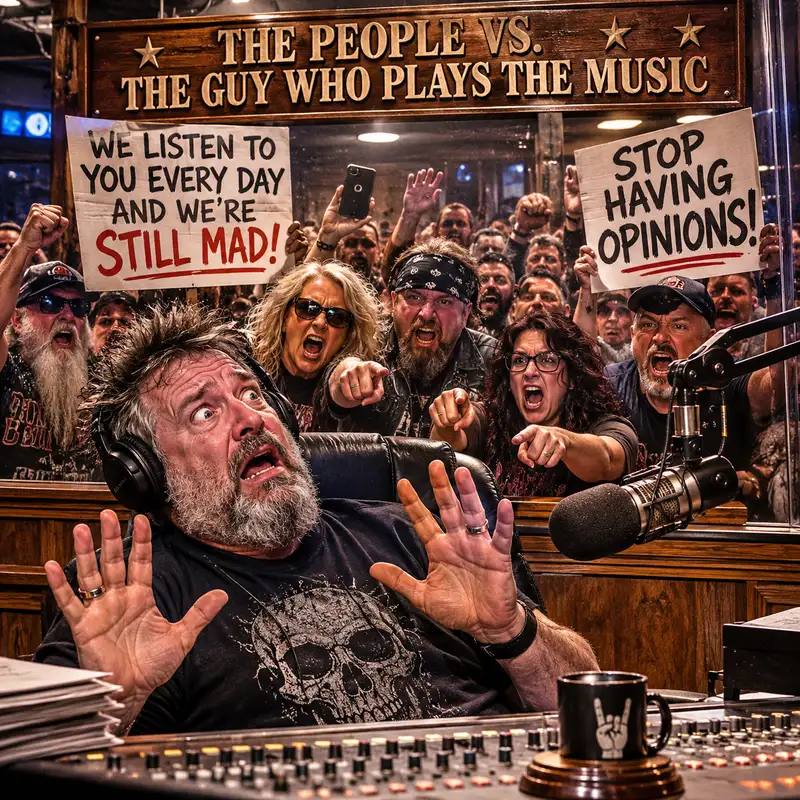
One listener calls to complain that Viktor should stop discussing politics because K-Bear is a rock radio station, not a political talk station. Viktor's response is essentially an immediate and enthusiastic NO. He argues that a radio personality should be able to discuss things beyond the music being played, and points out that his program covers everything from disgusting internet stories to strange news, community events, personal experiences, and occasional political commentary. He even invokes Howard Stern's movie Private Parts, referencing the idea that angry listeners sometimes continue tuning in precisely because they want to hear what the controversial personality is going to say next. The caller insists people tune into K-Bear for rock music, while Viktor suggests that anyone who wants nothing but uninterrupted music can simply open Spotify, choose their own playlist, or switch to another radio station. The exchange becomes increasingly entertaining as Viktor points out that bands such as Rage Against the Machine and System of a Down regularly appear in the news because of their political positions. Are we supposed to ignore those stories because they involve politics? Should he avoid discussing musicians with opinions? Should he only talk about guitar strings, record releases, and whatever acoustic guitar players Zakk Wylde happens to enjoy? Viktor argues that the difference between traditional music streaming and radio is the personality behind the microphone, and he isn't particularly interested in turning his show into an automated playlist with occasional advertisements. The caller eventually disconnects, but not before giving Viktor exactly the sort of live radio confrontation he seems to enjoy.
Another longtime listener, Stuart, calls in with a more supportive perspective. He explains that part of the reason he continues listening is because he never knows what Viktor is going to discuss next. The conversation moves through previous podcast subjects, including a dead camel with a skeleton on its back terrorizing Arizona, recommending disgusting horror novels to BYU-Idaho students on an airplane, Grand Theft Auto, a guy fighting a bear in his daughter's bedroom, a five-day fart retreat, and somebody having an emotional breakdown over 25 cents worth of ice cream. Viktor points out that the vast majority of his programming is ridiculous entertainment, and that the occasional discussion of something affecting everyday life shouldn't be treated as some sort of broadcasting emergency. He officially declares the K-Bear complaint line open and invites listeners to call him directly rather than contacting management because they disagree with something he said. If people want to argue, he's more than happy to sit there and do it. This is now an interactive radio program fueled by disagreement, stubbornness, and the possibility of somebody getting dumped for swearing.
Another caller comes through to support Viktor's healthcare discussion, describing the financial pressure of working 40 hours a week while struggling to afford insurance. The listener shares his own frustration with medical expenses and prescription costs, explaining that he personally avoids seeking medical treatment because he feels the expense is simply too high. He also discusses his experiences with type 2 diabetes and his frustrations with the healthcare system's approach to treatment. The conversation expands into the broader problem of people being unable to afford medical care, the role of private insurance, and the way social media algorithms reinforce political echo chambers by continually presenting people with opinions they already agree with. Viktor explains that he isn't telling people which candidates to vote for or attempting to turn his program into a partisan political broadcast. He's discussing issues that affect ordinary people and offering a perspective that might not otherwise appear in someone's social media feed. They also discuss the fact that radio stations have community responsibilities, and that interviews with charitable organizations, local news, community developments, and other nonmusical subjects are perfectly legitimate parts of broadcasting. Viktor asks why nobody complains when a radio station discusses sports, even though sports programming has just as little direct connection to rock music as many of his other topics. The caller agrees, and the two make the point that radio is about much more than simply playing songs between advertisements.
The conversation continues into the strange modern practice of employers investigating prospective employees through their personal social media accounts. The caller discusses experiences with job interviews where employers apparently examined Facebook posts and made judgments about his personality based on the material he liked or shared. He argues that personal social media activity shouldn't necessarily determine someone's professional qualifications, while acknowledging that employers frequently look through applicants' online histories. Viktor relates to the broader frustration of having people contact management or demand somebody's termination simply because they disagree with something posted online. They discuss the importance of being able to disagree without trying to destroy somebody's livelihood, and the fact that people have the option to stop listening, unfollow someone, or move along without turning every disagreement into a full-blown professional crisis.
Another caller joins the developing complaint-festival and makes it clear that he's completely comfortable with Viktor discussing whatever he wants. He references attending a Highly Suspect show where the performer discussed politics, arguing that audiences have the freedom to decide whether they want to attend a performance where those subjects are part of the experience. The conversation turns to musicians who incorporate religious commentary into their performances, with Viktor pointing out that listeners and concertgoers have the same freedom to decide whether that content appeals to them. He explains that he's from Idaho, comes from a family of ranchers, hunters, and cowboys, and understands the audience and station he works for. He insists that his healthcare comments were not some grand declaration about which political party people should support, but a relatively straightforward observation about how private insurance operates. The caller also manages to work in a spontaneous promotional plug for The Advocates Injury Attorneys, pointing out that insurance companies frequently try to minimize payouts and that people involved in accidents may need help dealing with them. Viktor appreciates the unexpected advertising opportunity and jokingly wonders whether the sponsor might be concerned about his earlier insurance commentary. Somehow, even the complaint line has become a commercial opportunity.
By the end of this extraordinary broadcasting experiment, Viktor has reached a compromise with the imaginary army of people who apparently believe rock radio should contain absolutely nothing except rock music. For the upcoming noon hour of Madness and Mayhem, he announces that he will discuss NOTHING BUT ROCK NEWS. No political opinions, no controversial commentary, no unrelated observations, and absolutely no editorializing. He's even going to avoid mentioning bands whose identities or public activities might involve political subjects. Rage Against the Machine? Off the list. System of a Down? Nope. Kid Rock? Forget it. Dropkick Murphys? Absolutely not. The Sex Pistols? Better not risk it. Viktor sarcastically asks listeners to provide him with a comprehensive list of politically associated bands so that he can avoid discussing any of them. He promises a clean, straightforward, completely opinion-free rock news segment, apparently because the modern radio listener has decided that hearing a DJ express an opinion is now an unacceptable violation of the musical broadcasting contract.
And with that, another morning of The Viktor Wilt Show comes to an end. We've traveled from a Finnish radio enthusiast capturing Idaho farm programming 200 miles above the Arctic Circle to the potential extinction of bullfighting, sobriety advice, veterans' Christmas assistance, library restrictions, a 97-year-old disco enthusiast dying to the Bee Gees, politicians failing to change clocks, nipple-induced existential dread, experimental weight-loss science, a shoplifting mayor, industrial laundry operations, an apparent police invasion of Idaho Falls, a collection of Idaho murder encounters, the American healthcare system, and an increasingly heated debate about whether a rock radio DJ is legally permitted to have thoughts. It's a spectacular collection of topics that somehow manages to make the world seem both hilarious and deeply concerning. If you came looking for nothing but guitar riffs and album release announcements, congratulations: you've accidentally wandered into a three-hour investigation of humanity's questionable decision-making processes. And if you called to complain, well, the complaint line was open. Viktor was listening. And apparently, so was everybody else.